Dental Fear
Dental Fear · Warrnambool
Does the thought of the dentist send shivers down your spine? You set the pace.
Fear should never stand between you and the care you deserve. We listen without judgement, explain everything before we start, and you decide when we stop and when we continue.
Prefer to talk first? Tell reception you're nervous. That's all you need to say.
of our new patients tell us they feel anxious about the dentist. You are far from alone.
nervous patients supported every day through our structured approach.
people return every six months after years away. However long it's been, no judgement.
sleep dentistry cases each month, across IV sedation and general anaesthesia.
Why it feels this way
Dental fear is real. It usually comes down to three things.
Studies have found that patients fear three things in the dental chair: loss of control, embarrassment and pain. Here's how we answer each one.
Losing control
You agree a stop signal with us before anything starts, and we pause the moment you use it.
Embarrassment
Whether it's been two years or twenty, we listen without judgement. You'll be heard, not lectured.
Pain
Prenumbing, a slow, gentle anaesthetic technique, and time for it to work before we begin.
What is dental fear?
Dental anxiety is fear, anxiety or stress in a dental setting. It can be triggered by needles, drills or simply the surroundings, and it often leads people to delay or avoid treatment altogether.
When the fear becomes intense and leads to complete avoidance of the dentist, it may be considered dental phobia. It remains one of the biggest barriers to people getting the care they need.
Signs and symptoms
People with dental anxiety may experience:
- Sweating
- A racing heartbeat or palpitations
- Low blood pressure and possible fainting
- Visible distress, crying or panic
- Withdrawal, or using humour or aggression to cover anxiety
How to cope with dental fear
- Tell us about your fears. Once we know what worries you, we can work out together what makes you most comfortable.
- Take part in decisions. If losing control is a stressor, discussing your treatment with us can ease the tension.
- Ask us to talk you through it. We'll tell you what's happening at every stage, so you can prepare.
- Use a stop signal, like raising your hand, whenever you need a rinse, a breath or a break.
If a dentist doesn't take your fear seriously, find another dentist. We will.
It starts before you arrive
Your first phone call is where we start looking after you.
Our reception team listens for what worries you, notes your triggers, and matches you with the nurse whose personality suits you best. So the right person is beside you from the very first visit.
Ash is exceptional with children.
Lily is naturally calming for gentle, soft-spoken adults.
Our signature approach
Seven steps that put you in control
No surprises, no rushing. Every visit follows the same method, whichever clinician you see.
Listen
We ask what makes you most nervous and take the time to understand it.
Personalise
Together we make a simple comfort plan based on what works for you.
Prepare
We explain what will happen before we do anything, so nothing comes as a surprise.
Give you control
We agree a stop signal, and you decide when you're ready to continue.
Comfort first
Prenumbing, distraction, and a slow, gentle anaesthetic technique.
Never rush
We give the anaesthetic time to work and check you're comfortable before starting.
Remember
We record what helped, so you never have to explain your fears again next time.
Our goal isn't simply to make injections less painful. It's to make you feel safe, heard and in control from start to finish.
Small things, big difference
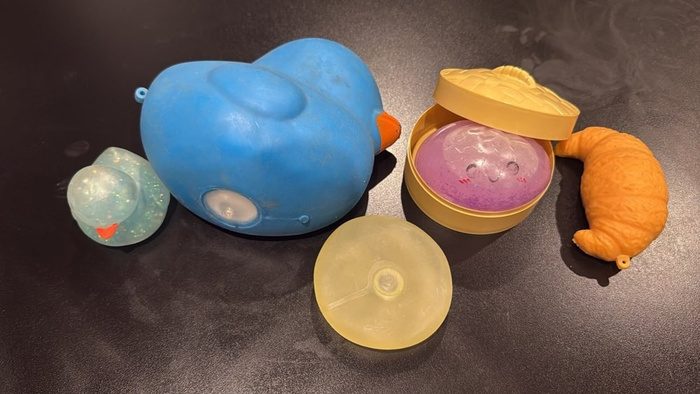
Something to hold on to.
Pick a glitter duck, a croissant-shaped stress ball or our smiling purple friend to hold during treatment. It sounds simple, but having something in your hands helps you feel grounded, distracted and in control.
And yes, the grown-ups choose them just as often as the kids.
Options for every level of anxiety
Anxiety sits on a spectrum. So does our support.
For many people, gentle communication is enough. For others, clinical support makes treatment possible. We'll talk through what suits you, and what's clinically appropriate, before anything is decided.
Behavioural & communication strategies
Where most people begin. Our seven-step method, your comfort profile and your stop signal.
Gentle local anaesthesia
The injection is often the biggest fear, so we treat it as its own comfort step: prenumbing, slow delivery, your pace.
Nitrous oxide (happy gas)
Well suited to children and needle-phobic adults. You stay awake and responsive while it takes the edge off.
Prescribed oral sedation
For strong anticipatory anxiety or a history of dental trauma. A middle step between happy gas and sleep dentistry.
Sleep dentistry
IV sedation onsite, or general anaesthesia in hospital, where clinically appropriate. Also used for complex surgery and several procedures in one session. About sleep dentistry
A whole-team approach
It doesn't depend on who you see. The whole team knows how to help.
Everyone is trained. Receptionists, nurses and dental assistants all learn anxiety-aware communication and proactive care.
Your preferences are on file. Your triggers, how you like things explained, and what helped last time.
A real person calls you afterwards. Not an automated text: one of us, checking how you're feeling.
2025 Australian Dentistry Awards
Recognised nationally, including for how we care for nervous patients
Warrnambool Dental took home three major awards and was a finalist in nine categories, among them Treatment of Nervous Patients – Patient Care.
Questions nervous patients often ask
It's been years since I've seen a dentist. Will I be judged?
Never. Every six months, several people come back to us after long gaps. We start by listening, not lecturing.
What if I need to stop halfway through?
We agree a stop signal before we begin. Use it whenever you need to, for a break, a rinse or a breath, and we carry on only when you say you're ready.
The needle is my biggest fear. What can you do?
We prenumb the area first, deliver the anaesthetic slowly, and give it time to work before we start. If that's still too much, happy gas or sedation may be options. We'll talk them through with you.
Do I have to explain my fears every visit?
No. We record what helped you, so the whole team knows your preferences next time.
Can I be asleep for my treatment?
Where it's clinically appropriate, we offer IV sedation onsite and general anaesthesia in hospital. We'll assess this with you at a consultation. Read about sedation
We don't just treat teeth. We restore trust, dignity and confidence, one nervous patient at a time.
454A Raglan Parade, Warrnambool VIC 3280 · Mon–Fri 7:30am–7:30pm · Sat 8:30am–4pm
info@warrnambooldental.com.au · Ample parking across the road
We accept EFTPOS, all major credit cards, HICAPS and all major health funds, including MBF, Medibank Private and HCF.
Any surgical or invasive procedure carries risks. Before proceeding, you should seek a second opinion from an appropriately qualified health practitioner. Sedation and general anaesthesia are offered only where clinically appropriate, following assessment.